Finds prospects from custom data sourcesWrites letters in ink + follows up onlineYields ~11% positive replies, by founder of Foodora & Kaia
Let me find the 100 people a month most likely to need your service, with a data pipeline built just for you.
Free, no sign up needed to see the first letter and who it goes to.
How does it work?
We walk through it with Carewatch, a made-up example. It helps doctors’ practices spot the patients who stop showing up, before they cancel their membership.
- 1
Research and approve
Every month Lioma finds 100 people with a live reason to hear from you. You approve each one with the reason, the source and the letter written in your voice.
We find out when a founder hands the CEO role to a manager and stays on the board.
- 2
The letter arrives
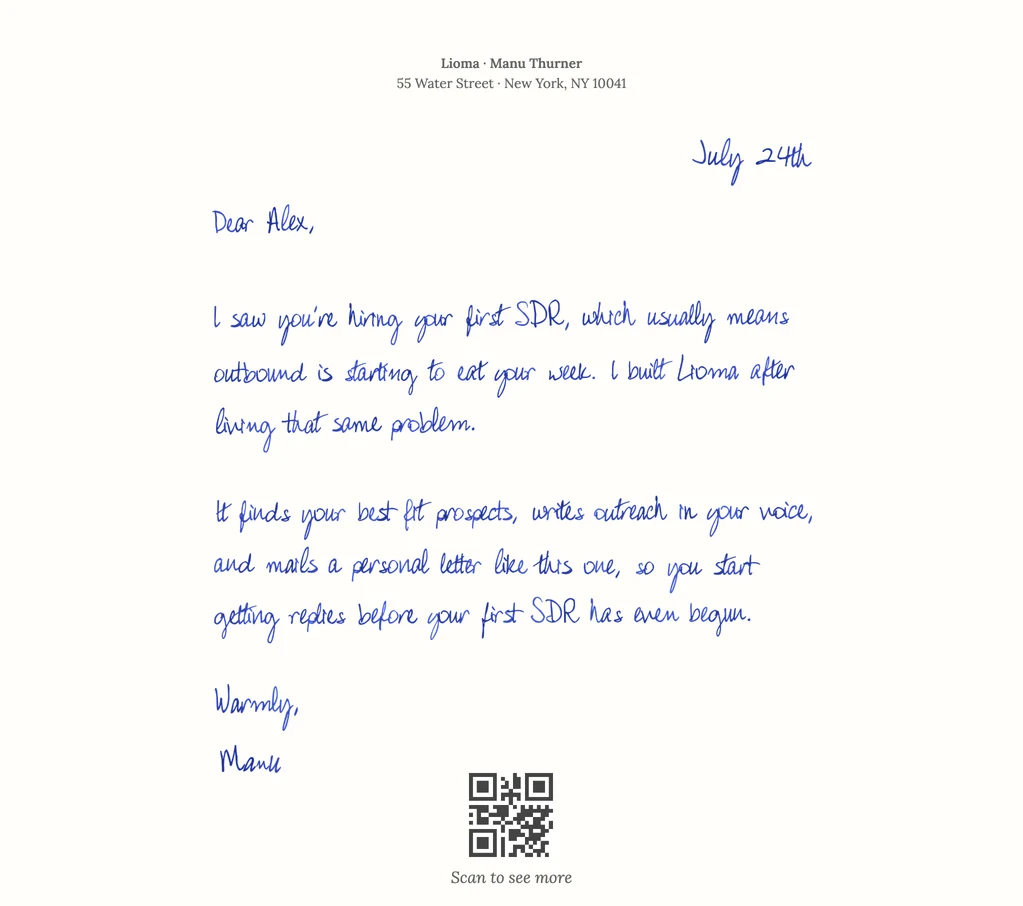
Real ink on real paper, in an envelope with their name on it. The first sentence is about them, not you. A QR code at the bottom opens the page you built for them. We find each recipient’s current postal address, so you never type one.
- 3
They open your page
Not your homepage. A page written for them that gives them something useful before they decide anything, in their own numbers or their own situation. Then one clear ask: a call, a meeting, or a reply.
- 4
The ice is broken
Once the letter lands, Lioma follows up on LinkedIn and by email. What comes back sharpens next week’s list and letter. You step in when someone wants to talk. Twenty minutes a week from you. That’s the whole job.
Lioma runs your outreach on every channel
- Letterarrives within 7 daysLioma
- LinkedIn connection3 business days after arrivalLioma
- Email8 business days after arrivalLioma
- LinkedIn message15 business days after arrivalLioma
- Callonce the prospect respondsYou
What numbers to expect
Before asking anyone to trust Lioma with their outreach, we ran it on our own. Lioma chose who to write to, wrote 500 letters and followed each one up on LinkedIn and by email.
500 letters, 30 new customers.
- 6%replied to the first letter
- 11%replied after the follow-ups
- 55%of those replies became customers
The campaigns that worked best gave something away in the very first letter: a finding about the reader’s own business, worth having even if they never answered. That reads like free consulting, not like an ad, and it is why people write back.
Real replies to a cold list
Real replies only: no auto-replies, no “remove me”.
Sources. Lioma: our own campaign of 500 letters. Cold email: Belkins, 7.5 million emails sent in 2025, auto-replies excluded; Hunter, State of Email Outreach 2026, 31 million emails, every reply counted. Printed letter: DMA Response Rate Report 2015, median for letter-size mail to bought lists; the CMC and Deutsche Post print mailing study 2021 found the same.
One of my letters. Click to see how it's made.
Before you ask
Who are you writing to?
People who are likely to need what you offer right now. I look for the public moment that shows it: a company hiring, a founder stepping back, a family selling, a building application, a practice opening a new location.
For eight industries those moments are already mapped in my field notes. If yours is not there, we map it together.
You see every name first and can remove anyone. Everyone who stays gets a letter about their own situation, with a QR code to a page made for them.
Why a letter?
Because a letter gets opened, and it makes every message after it warm. A LinkedIn message that says “I sent you a letter last week, did you get it?” is not cold outreach anymore.
It has worked before. A young Warren Buffett wrote to Benjamin Graham and got the job that started his career. The founders of Celonis sent handwritten notes to the CEOs of Europe’s largest companies, and those letters got them into the room.
Will it sound like me?
Yes. We write the first letter together: I draft, you tell me what is off, and I learn from it. After that you approve every batch before it goes out, and you will edit less every month.
What can I change?
The list, the letters, and who we never write to. Remove anyone, or give me your own list. Edit any letter and I learn from it. Nothing goes out without your approval.
How much of my time does this take?
About twenty minutes a week. The first week takes a bit longer while we set up your signals and leads together. After that you approve a batch of letters and read a short update on what came back.
Can I send letters to people who never asked?
Yes. A personal letter is the most accepted way to write to someone you have not met. In the EU, writing to a business about its business is a legitimate interest, and a letter to a private owner about their property or company is allowed too, as long as it says where their address came from and stops when they ask. In the US, mail has no such restriction. Every letter names its source, and the QR code takes the reader off the list in one tap.
Which countries can you send to?
The US, Canada, Australia and all of Europe, including the UK. A letter arrives in four to seven business days. It is printed and posted in the region it goes to, on the local paper size, in a handwriting style you pick.
What does it cost?
50 people a month for €500, 100 for €900, 200 for €1,600, or 400 for €2,900, plus VAT, plus €100 for each conversation that comes about. Every plan researches up to 500 contacts a month, depending on your data pipeline, and reaches its share of them personally with the full sequence: a researched letter with a page made for its prospect, then LinkedIn, and email where the law allows. Founders before their seed round can start on the Plan for Pre-Seed Founders: 10 letters a month for €79, with no conversation fee. Month to month, no setup fee, no minimum. Whether it pays off is what a conversation costs against what one customer is worth to you. The calculator below does that sum.
How fast do I know if it is working?
There are two points, the same for every campaign, and a letter counts once it has had two weeks to get an answer. After 48 of those, about 5 weeks in, you get a first read: who scans, from which companies, and who wrote back. After 150, about 9 weeks in, you get the verdict: it works, it does not, or it is unclear, and then we change one thing and count again. You need one decision, not a precise percentage, so you do not need thousands of letters. The chance that I call a working letter a failure is about 5%, and every week I tell you where you stand.
Is it really handwritten?
We use a combination of ink on the envelope, algorithmic fonts and handwriting robots to get close to a letter written by a human hand.
How is this different from other services?
There are several great services that write handwritten letters to an address list you provide. Lioma is the only one that keeps researching your buyers: it builds each one's full profile from the web, current address included, creates a page made for their company, and sends them the letter. Then it follows up through the usual channels until it can hand you a warm conversation.
What if I already have my own lead lists?
Then we write to them. Upload a list, or connect your CRM: we integrate with Affinity, Attio and HubSpot, and with others on request. The data flows in both directions. You can start letters and their follow-ups from your CRM or from Lioma, whichever you prefer. Whether a letter arrived, whether its reader opened their page and what they replied shows up in your CRM, next to everything else you know about them.
What if it doesn't work?
You can cancel anytime. If you don't see any success, I can also refund you the first month.
Do the math
Return per customer won
One customer costs about €331 to win, conversation fees included, so it pays for itself once a customer is worth more than that to you. A first read in about 5 weeks, a verdict in about 9.
Our own case study: 11% real replies after follow-ups. Cold email reaches about 3% even counting auto-replies (Hunter 2026), a printed serial letter about 1% (DMA).
Let’s write your first letter together

Everyone crowded into the inbox, so I write where a message still gets through: a real letter on the desk.
A letter gets opened because almost nobody sends a good one. Most outreach tools send a templated text to a list you give them. I find out who is worth writing to, why now, and write to that one person.
At Foodora we sent mail to a whole district. At Kaia Health we wrote to patients and doctors alike, and it tripled our revenue. Whether you sell software, advise practices, buy companies, manage wealth or sell property, the right letter in the right week works the same way. Let’s try it for you?