
Let's find your future customers, write each one a letter in your voice, and put a stamp on it.
Who this is for

You sell to other businesses, and you are past the first customers who already knew your name.
It works best where one new account is worth chasing: tech, real estate, finance, insurance, healthcare.
It is for anyone who wants someone researching the right people and writing each one a handcrafted letter, while you sleep.
Say you sell community-management software. I find the companies that just opened a community-manager role, write to each off their recent posts, and adapt one of your case studies to their situation so it lands.
All for a fraction of what an intern costs.
Why it works

I have built this channel twice. At Foodora we signed restaurants by hand. At Kaia Health we wrote to doctors. Both companies were acquired.
A letter gets opened because almost nobody sends a good one. I research each company off a buying signal and write to that one person. The address is handwritten. The paper has weight.
AI made building the product easy. Distribution is the hard part now. Everyone crowded into the inbox, so I write where a message still gets through: a real letter on the desk.
What happens
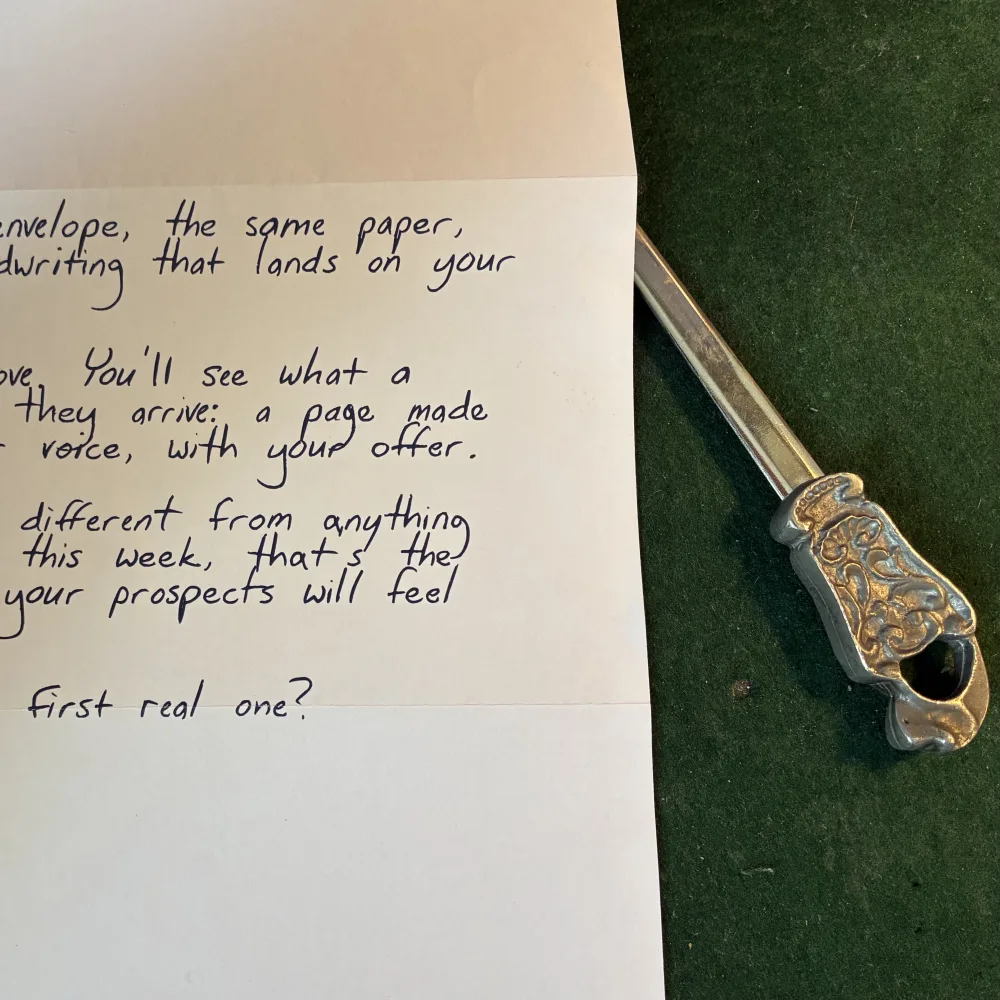
Week one: I research who is worth writing to and draft the letters in your voice. You read them. Nothing goes out under your name until you say yes.
Week two: The letters land, then LinkedIn and email follow-ups, because a busy buyer means to reply but needs the nudge. I watch who answers. You step in when someone wants to talk.
Every week: Keep what worked, cut what didn't, send sharper.
Every quarter: A call with me, Manuel, to review the playbook and decide what to try next.
Twenty minutes a week from you. That's the whole job.
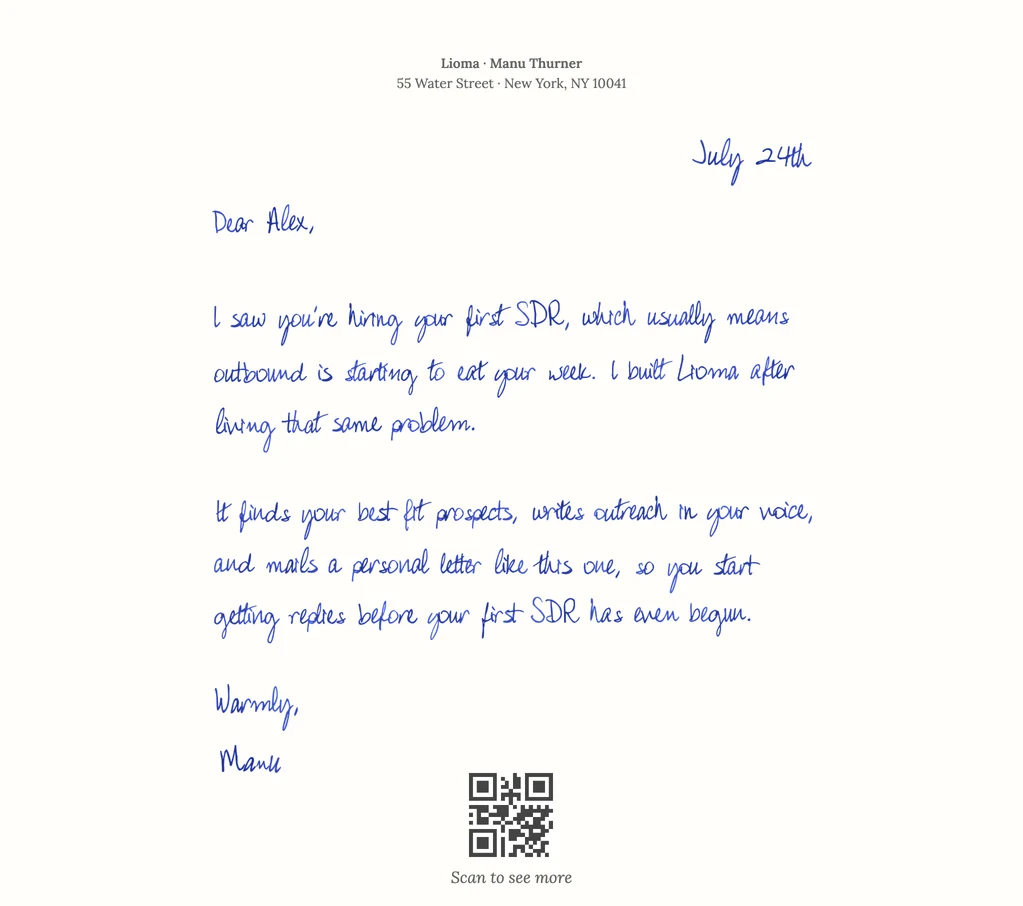
One of my letters. Click to see how it's made.
Before You Ask
Who are you writing to?
I identify your buyers from your website and surface the ones giving off live signals: a new hire, fresh funding, company news that says now is the moment. You see who I found and can correct me anytime, or upload your own lead lists. Then I find the right address and build each prospect a landing page that shows real value, like how one of your case studies applies to their company. The prospect will receive a heavy letter addressed to their office, with a personalized hook, your value proposition, and an actionable QR code leading to the landing page.
Will it sound like me?
We write the first letter together: I draft, you nudge it with a line or two of feedback, and I learn from that. You never have to write anything yourself. Then you approve each batch before it goes out. You will adjust a few the first month and almost none by the third, which is how you know it is working.
Is it really handwritten?
Printed. I'll never tell you otherwise. But printed right: heavy stock, an algorithm that varies every stroke, so no two pages match. I ran it against the machines that hold a real pen, and people picked mine as the more human one. Here's the thing: the ink was never the point. The point is a letter written about their company, for one person, that lands on their desk. And when a prospect asks, you have a straight answer: the handwriting is machine-made, the decision to write to them wasn’t. We don’t print that on the envelope, because the handwriting has one job, to get the letter opened. After that, you can say exactly how it came about.
Can I send letters to people who never asked?
Yes, and on firm legal ground on both sides of the Atlantic. In the EU two articles carry it. Article 6(1)(f) is the basis for writing at all: business outreach counts as a legitimate interest, which is why the rules that strangled cold email left the letterbox alone. Article 14 is the duty that rides along with it: because you found them rather than the other way round, the first contact has to say where their details came from and how to stop it. That line is on every letter, and the page behind the QR code takes them off the list in one tap. In the US, a letter to a business office carries no such restriction, and cold email is legal under CAN-SPAM as long as it names you and offers an easy way out. LinkedIn messages stay within the platform's own terms of use. Across every channel: business addresses only, opt-outs honoured, no consumer lists.
What does it cost?
$519 a month, plus VAT. Your weekly letters, the research, the follow-ups, the weekly read on what came back. Month to month, no setup fee, no minimum. Whether it pays comes down to $519 against what a customer is worth to you. Run your own numbers in the calculator below.
How fast do I know if it is working?
Two questions, and they resolve at different speeds. Whether it works: a reply rate starts to mean something once about 48 letters have landed and had a fortnight to be answered, so roughly six weeks in. Whether it does not: silence is weaker evidence than a reply, so ruling an angle out honestly takes 153 letters, more than twice as long. The three follow-ups are what buy that number down, because silence from someone we asked again and again is worth far more than silence from someone asked once. Every week I tell you where on that road you are, so a quiet month reads as a position and not a verdict.
Do I not need hundreds of letters before the numbers mean anything?
You would for a poll, and you are not running one. A poll pins a percentage to the decimal; you need one decision, whether this buyer and this message clear the floor, and that costs far less evidence. Three things pay for the rest. Each person is asked up to four times, not once. Anyone who opens their page, takes two more follow-ups and still says nothing has answered you as clearly as an email would. And the arithmetic underneath is cautious: it refuses to read a trend into forty letters. When the honest answer is still “too early”, that is what you get, rather than a small number dressed up as a finding.
How do you decide something is not working?
By counting, with the error rate stated up front. Detection needs a roughly fixed number of expected replies, not a fixed number of prospects, so the prospects you need is that count divided by your reply rate. That is what the follow-ups are for: they do not give us more trials, they raise the rate, which does the same work. Concretely: a standout angle proves itself inside 48 prospects, but at 48 there is no honest way to call anything dead yet, at any threshold. A collapse to a quarter of what a working campaign returns is caught 60% of the time by 110 prospects and 87% by 153. A milder shortfall, half of what a working campaign returns, takes 361. What we cannot do is rank one angle against another at this volume, and we do not pretend to. We accept about a 5% chance of calling a working angle dead to get those catch rates. The ladder, the worked example and the interval we use
What if it doesn't work?
You cancel with a week's notice and keep everything: the target list, the letters, and the record of which message got answered and which got silence. That travels into every channel you run next.
Do the Math
Estimated return
Lifetime return on what you pay us. Winning one customer costs about $1,038. The sliders below hold our estimates, so move them to yours.
5% is what we call a working campaign. Our bar, not an industry average.